Wednesday, June 4, 2014

The Library Company Goes 3D


Concetta Barbera, Curatorial Assistant and Digitization Specialist at the Library Company, viewing “racy” Victorian-era anaglyph stereographs in the “That’s So Gay” exhibition
With the resurgence in 3D viewing technologies in recent years, the Library Company has dared to revive this long-lived pastime through recent exhibitions and collaborations.  3D photographic imaging has existed since the 1840s with mid to late 19th century stereographs setting the trend that would eventually lead to View-Masters, 3D movies and even 3D cell phones and TVs.

After seeing the Library of Congress’s attempt to “3Dify” its stereograph collection, Concetta Barbera, Curatorial Assistant and Digitization Specialist at the Library Company (pictured above), converted several photographs for the viewing pleasure of our visitors to the Library Company’s recent exhibition on ephemera.  In our current exhibition “That’s So Gay: Outing Early America,” visitors can don a pair of 3D glasses and “peek” at an iPad set up in the gallery which showcases Victorian-era stereographs with a voyeuristic theme.

Screenshot of Paul Taylor’s Anaglyph of a street scene stereograph from the Raymond Holstein Stereograph Collection at the Library Company: https://flic.kr/p/nqoxzT
Most recently, Paul Taylor located stereographs on the Library Company’s Flickr Commons page uploaded by previous summer Print Department intern Kat Poje and is converting them into 3D anaglyph images, making his creations publicly available on his Flickr page.  Taylor has developed a keen eye for stereograph images that really “pop” when viewed, exhibiting a nearly tangible 3D experience.  Those interested can view his creations here (you will need to track down a pair of 3D glasses in order to view the images in 3D): https://www.flickr.com/photos/110677094@N05.

So join the 3D craze by visiting Taylor’s images (Library Company images are tagged “Library Company of Philadelphia”) or stop by our gallery to view our 3D images displayed in our current exhibition.

Nicole Joniec
Print Department Assistant & Digital Collections Manager

Thursday, May 29, 2014

World War One Posters and a Philadelphia Connection


World War One poster by Jessie Willcox Smith P.2284.107
The Jessie Willcox Smith Photograph Collection in the Print and Photograph Department is not the only place to find the famed illustrator’s work at the Library Company of Philadelphia. Smith was one of the many talented artists recruited by the United States Committee of Public Information to create propaganda posters during World War I. In 1918, Smith designed “Have You a Red Cross Service Flag?” a poster which Pennsylvania poster dealer George Theofiles labeled as, “a very popular poster done by an equally popular children’s book illustrator of the period” (Theofiles, American Posters of World War I, 169).

An article in the 1918 Thanksgiving issue of The Red Cross Bulletin described this poster even more enthusiastically:

“In the Jessie Willcox Smith poster the Red Cross Christmas Roll-Call will present one of the finest studies of child life ever painted. It is a window scene which it is hoped will be reproduced in every home in the country. A little boy is fixing a Red Cross service flag in his window to indicate that his home is 100 per cent enrolled. A Christmas wreath is suspended above. Miss Smith set aside all her regular orders and work to produce this poster for the Red Cross.”
A Philadelphia native, Jessie Willcox Smith (1863-1935) studied at the Moore College of Art (then the School of Design for Women), the Pennsylvania Academy of the Fine Arts, and with Howard Pyle at the Drexel Institute. Smith lived with fellow artists Elizabeth Shippen Green and Violet Oakley, who collectively became known as the Red Rose Girls. Smith not only grew into a nationally recognized children’s book illustrator, she also designed the cover of the magazine, Good Housekeeping, from 1918 to 1932.
Jessie Willcox Smith collection P.9446.field
Smith frequently took portrait photographs to use as studies for her illustrations. Two photographs within the Library Company’s Jessie Willcox Smith Collection indicate that she may have been planning to design additional World War I posters (see above and below). These two character studies show a sailor seated either on a porch or in a field pointing towards the horizon. I have not been able to track down posters created from these photographs, but please let us know if you are aware of any related images.
Jessie Willcox Smith collection P.9446.porch
Becca Solnit
LCP Intern

Wednesday, May 21, 2014

Canoeing the Pine Barrens


Deserted House at Atsion, N.J.  May 18, 1906. Thomas C. Potts second from right. From the Library Company’s Marriott C. Morris Photograph Collection.

Though a desolate landscape, Philadelphians have long been drawn to the Pine Barrens of New Jersey for various reasons such as relaxation, trade, and industry.  The Marriott C. Morris collection of photographs includes views of amateur photographer Marriott C. Morris’s travels to the Pine Barrens for leisurely activities.

In the above photograph, Morris takes pictures of those on his canoeing trip along side the slab-sheathed house, believed to be one of the oldest structures still standing in Atsion, potentially dating back to the industrial town’s beginnings in the 18th century.  Today, what once served as a canal to power a nearby mill, this location is overgrown with foliage and is difficult to photograph, even on an early spring day (see below).  The house still stands but enhancements were once made to the back porch and accompanying outbuilding (the residence is now vacant).  Given the placement of the canoe in an area that most likely would not have been frequented by canoes, as it only served as a waterway to power the nearby mill, it appears this photograph was taken as a perfect photo opp where Morris could stand upon the nearby bluff while the canoeists posed in the calm waters.

 Modern photograph of Slab-Sheathed house taken on 4/6/2014 by the author
Photographed on what seems to be the same canoeing trip, since both photographs are dated May 18, 1906 and the Mullica River runs past the slab-sheathed house, the photograph below shows the canoeists porting their canoes over fallen timber amongst the sparse pine barren scenery.  Given the vantage point of the photographer, it appears Morris may have been standing in the river or perhaps we cannot see the riverbank or fallen log from which he shoots.

  Canoeing on the Mullica River.  May 18, 1906.  From the Library Company’s Marriott C. Morris Photograph Collection.
These two Morris photographs show only a glimpse of views of the Pine Barrens represented by the Marriott C. Morris collection.  Interested researchers can also find images of Allaire, an historic mill town located in Monmouth County, as well as many photographs of the nearby New Jersey shoreline.  More information on the Morris collection can be found in a previous blog post I authored.  And stay tuned as we are excited to announce we will be embarking upon a mass digitization project to make the entire Morris collection available online in the coming years, thanks to a generous donation made by Marriott C. Morris’s grandchildren David Marriott Morris, Eleanor Rhoads Morris Cox and William Perot Morris in memory of Marriott Canby Morris.

Nicole Joniec
Print Department Assistant & Digital Collections Manager

Monday, April 14, 2014

So Who Really Made the First American Flag?


Every school student has been taught that George Washington and his committee tasked Mrs. Elizabeth Ross, a milliner whose business was located between 2nd and 3rd on Arch Street, with the creation of the first American flag. Supposedly, the agile seamstress dazzled this group of august gentlemen by quickly snipping out one of the now-famous five-pointed stars with only one clip of her scissors.

The first postcard portrays the home of Betsy Ross as it appeared at the beginning of the twentieth century. Strangely, the card’s caption reads “The First Flag of the U. S. was made in this House by Mrs. A. Mund,” and a small replica of the flag, suspended from the second story, bears the inscription “The first flag was made in this house. Mrs. A. Mund.” Who was this woman, and why was her name linked to the famous Flag House?

                     
P.2013.77.1.14 Home of Betsy Ross postcard, ca. 1907. Gift of Philippa Campbell.


In 1876 or 1877 Philip Mund opened a beer saloon at 239 Arch Street. Forty-five years later, his widow, Mrs. Amelia Mund, now proprietress of the saloon, aware of the importance of this historic building thought to have been the Ross establishment, noted that there had never been a sign identifying it as the site where the first American flag had been produced.

So, mystery solved: This postcard’s creator mistakenly combined the statements on that advertising signage. It should have read, “The first flag was made in this house,” (period, end!), and should have been followed by the statement: “This building was later owned by Mrs. A. Mund.”

In 1937, a donation of $25,000 by Philadelphia radio magnate A. Atwater Kent paid for the necessary radical surgery that was performed on the dwelling’s interior and exterior. The second postcard view, circa 1950, shows the front doorway moved to the far right corner and the original plate glass window replaced by a shuttered pane. The building to its left, purchased by Kent, was later renovated into a courtyard.

                 
P.2013.77.1.48 Betsy Ross Flag House postcard, ca. 1950. Gift of Philippa Campbell.

These two views are from a collection of more than 230 Philadelphia postcards generously donated to the Library Company in 2013 by Ms. Philippa Campbell. They are currently being processed into the LCP postcard database.

Gus Spector
LCP Volunteer


Friday, April 4, 2014

Except New Jersey


Francis Hopkinson trade card, ca. 1769.

In fall 2013 the Library Company seized upon the tremendous opportunity to acquire the Joe Freedman Collection of Philadelphia Ephemera. A boon to our visual culture holdings, I have recently had the privilege to begin to process this extraordinary collection of over 900 items that speak to the everyday lives of past Philadelphians.

Starting with the path of least resistance, that is, pockets of the collection already somewhat organized by genre, I have begun my archival journey with early trade cards. Unlike the trade cards that come to mind for the Victorian period, these advertising gems serve as specimens of early types and ornaments, verbose and telling promotional text, and the artistry of those who designed in extreme miniature. The materials offer a history of trade card design with cards more indicative of small prints like Francis Hopkinson’s circa 1769 advertisement for his cloth business to mid-19th century ticket-size missives more reminiscent of today’s business cards.


Davis & Birney trade card, ca. 1850.


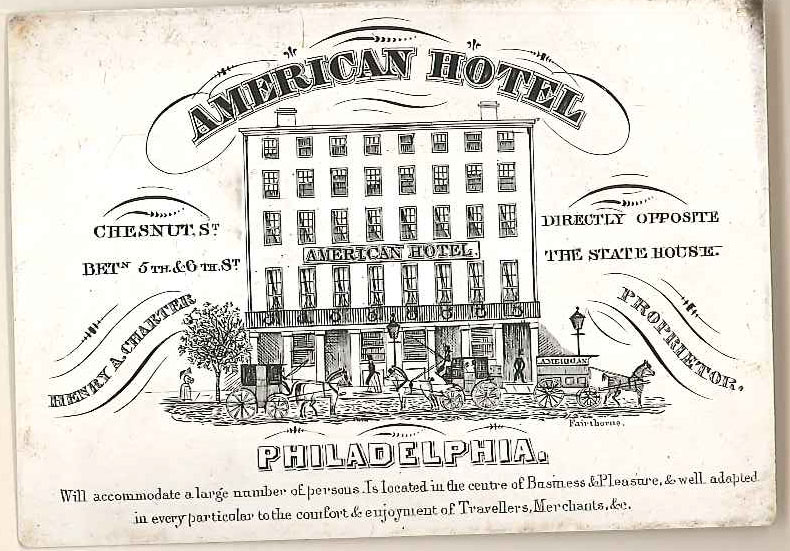
A few favorites so far include this circa 1850 trade card for Philadelphia commercial agents Davis & Birney. They refer recipients to a long list of references as well as the notice that Birney is “Commissioner for all the States, (Except New Jersey).” Another is this circa 1848 card for the American Hotel. The modern design aesthetic reminds me of magazine advertisements from the1920s.
American Hotel, ca. 1848.

Although smitten with the collection since I was first fortunate to review it, my infatuation with it continues to grow with each piece. With treasures to be found on the front and back of each card from the graphics, text, and personal inscriptions so often left behind, my unending inquisitiveness about the history of Philadelphia’s visual culture thankfully continues on with new acquisition like the Freedman Collection.


Erika Piola
Associate Curator, Prints and Photographs
Co-Director, VCP at LCP